(Image source from: english.mathrubhumi.com)
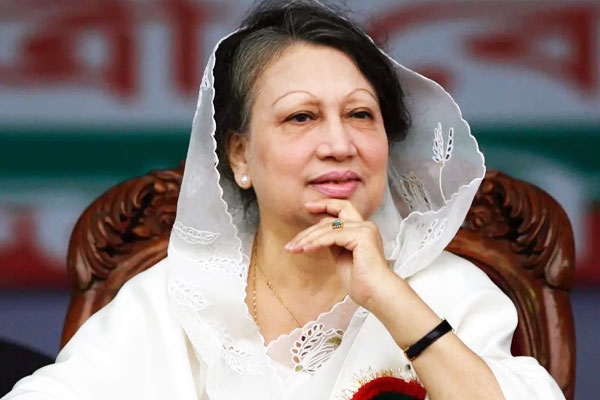
Bangladesh's previous Prime Minister Begum Khaleda Zia, who many thought would easily win the elections next year to once more guide her nation, has passed away following a long illness while receiving care at Evercare Hospital in Dhaka. She was 80 years old. The Bangladesh Nationalist Party (BNP) chairperson died at 6 am on Tuesday, as noted in a statement from her party. Zia had been receiving treatment for 36 days after being admitted on November 23 due to infections in her lungs and heart. She was reported to be suffering from pneumonia as stated by The Daily Star, a Bangladeshi newspaper. "The BNP Chairperson and former prime minister, national figure Begum Khaleda Zia, is no longer with us, having died today at 6:00 am, just after the Fajr (dawn) prayer," read the party’s announcement.
"We ask for forgiveness for her soul and encourage everyone to pray for her," it continued. Zia, who was the first woman to hold the prime minister position in Bangladesh, had been struggling with various health issues including liver cirrhosis, arthritis, diabetes, and ongoing problems with her kidneys, heart, lungs, and eyesight. Her medical care was managed by specialists from Bangladesh, the UK, the US, China, and Australia. Earlier this month, there was a plan to send her abroad for medical assistance, but her weak condition prevented this from happening. She is survived by her eldest son, Tarique Rahman, his spouse, Zubaida Rahman, and their daughter, Zaima Rahman. Tarique Rahman returned to Bangladesh on December 25 after spending 17 years in exile. Zia's younger son, Arafat Rahman Koko, passed away a few years back in Malaysia. Prime Minister Narendra Modi shared his sadness regarding Zia's passing. In a message on X, he said, “I am deeply saddened to hear about the death of former Prime Minister and BNP Chairperson Begum Khaleda Zia in Dhaka.”
"Our heartfelt condolences go out to her family and all the people of Bangladesh. May God give her family strength to endure this significant loss," he added. PM Modi acknowledged that Zia, being the first female Prime Minister of Bangladesh, made significant contributions to the country's progress and to India-Bangladesh ties that will always be remembered. "I fondly recall my meeting with her in Dhaka in 2015. We hope her vision and legacy will keep guiding our collaboration. May her soul find peace," he stated. Zia, who served as prime minister three times, began her political journey after being elected in the 1991 national elections. She proceeded to implement a parliamentary system of governance and established the caretaker government structure in Bangladesh to ensure elections were free and fair. She transitioned from a presidential system to a parliamentary system, ensuring that authority rested with the prime minister. She also removed barriers for foreign investments and made primary education free and compulsory.
Born in Jalpaiguri, British India, which is now known as West Bengal, in 1945, Khaleda's family relocated to Dinajpur, East Bengal, currently called Bangladesh, following the partition in 1947. Her father, Iskandar Mazumder, worked as a businessman, while her mother, Tayeba Mazumder, stayed at home. She was affectionately called "Putul" and was the second child among her three sisters and two brothers. After they settled in East Pakistan, Zia attended Dinajpur Missionary School and completed her matriculation at Dinajpur Girls' School in 1960. In the same year, she wed Ziaur Rahman, who was a captain in the Pakistan army at that time, and continued her studies at Surendranath College of Dinajpur until 1965, when she moved to West Pakistan to be with her husband. In 1971, with the start of Bangladesh's Liberation War, Ziaur Rahman revolted to fight for the new nation's independence.
Ziaur Rahman was killed on May 30, 1981. After his passing, his political party, BNP, faced significant challenges. To help maintain the party's unity, Khaleda Zia, who had not been involved in politics before, joined the BNP, which her husband established. On January 12, 1984, she was chosen as the party's vice-president and later on May 10, 1984, she became its chairperson.
Zia collaborated with Sheikh Hasina, the daughter of Bangladesh's founding leader and head of the Awami League party, to spearhead a popular movement for democracy that led to the overthrow of military ruler Hossain Mohammad Ershad in 1990. However, the partnership between Zia and Hasina was short-lived. Their ongoing rivalry would earn them the nickname "the battling Begums," using a term from Urdu that honors notable women.
In the parliamentary elections of 1991, BNP won a clear majority, and Zia was inaugurated as Bangladesh's first female prime minister. She secured a second term in 1996, but all major parties chose to boycott the elections' outcomes. In response to opposition, Zia's administration amended the constitution to introduce a caretaker government to facilitate parliamentary elections, assigning authority to Justice Muhammad Habibur Rahman.
In the subsequent elections, BNP lost to Sheikh Hasina's Awami League, and Zia became the Leader of the Opposition in the Jatiya Sangsad during Hasina's government. However, she returned five years later with a surprising overwhelming victory and was sworn in as prime minister for the third time on October 10, 2001.
Her second term was troubled by the rise of Islamist extremists and corruption claims. In 2004, a grenade attack struck a rally where Hasina was speaking. Hasina survived; however, the attack resulted in more than 20 fatalities and over 500 injuries. Zia's government and its Islamic partners were widely held responsible. In 2018, after Hasina regained the top position in Bangladesh, Rahman was tried in his absence and received a life sentence for the attack. The BNP condemned the trial as a politically motivated act. While Zia later took action against Islamist radical groups, her second term as prime minister came to an end in 2006 when a military-backed interim government assumed control amid political turmoil and public unrest.
The temporary government imprisoned both Zia and Hasina for around a year because of accusations related to corruption and misuse of authority before releasing them before the general elections in 2008. Zia did not regain her position of power. While the BNP refused to participate in the 2014 and 2024 elections, her intense rivalry with Hasina continued to overshadow politics in Bangladesh. The conflict between their political parties often sparked strikes, violence, and fatalities, hindering the economic growth of Bangladesh, a country of about 175 million people that faces challenges like floods and poverty. In 2018, Zia, Rahman, and their associates were found guilty of taking approximately $250,000 in foreign donations meant for an orphanage trust established during her last time as prime minister—claims that Zia stated were part of a scheme to prevent her and her family from entering politics again. She was imprisoned but was later placed under house arrest in March 2020 due to concerns about her health. Zia was released from house arrest in August 2024 after Hasina was removed from power.
In early 2025, Zia and Rahman were cleared of the corruption charges that led to their 2018 prison sentences by Bangladesh's Supreme Court. A month earlier, Rahman was also found not guilty in relation to the 2004 grenade attack targeting Hasina.